

Goal setting by personality type explores why two people can start with the same goal, follow similar advice, and still end up with completely different results. The same goal inspired one person and exhausted another. Here’s why.
Some people buy a planner and immediately become productive. Others buy a planner, spend two hours choosing the perfect pen, watch a few videos comparing notebook layouts, and accidentally start a new stationery hobby.
Relatable?
Most of us assume that successful goal setting comes down to discipline, motivation, or finding the perfect system. But one factor often overlooked is how much your personality type influences how you approach goals.
Researchers have long known that people are motivated by different things. Some thrive on challenge, others on purpose, structure, stability, or freedom. That’s why interest in MBTI personality types, personality-based goal-setting, and motivation styles has grown rapidly in recent years.
Some people are energized by challenge. Some are driven by purpose. Some crave structure. Others need freedom. And when we ignore those differences, we often end up following goal-setting advice that was designed for someone else.
What follows is a personality-first guide to goal setting, built around the four MBTI personality groups. Whether you are a strategic Analyst, a purpose-driven Diplomat, a structure-loving Sentinel, or an action-first Explorer, you’ll walk away knowing which goal-setting frameworks actually match how your mind works.
The reason most people don’t reach their goals is not a lack of effort. It’s a lack of self-knowledge.
– Jay Shetty
What is MBTI – Your Key to Goal Setting By Personality Type
One of the most widely recognized personality frameworks in the world is the Myers-Briggs Type Indicator (MBTI). Over 2 million people take the MBTI annually.
Did you know: 70% of Fortune 500 companies use personality assessments for leadership development.
Is MBTI perfect?
No personality assessment can fully capture the complexity of human behavior. But for understanding how you pursue goals, what motivates you, what derails you, and what success needs to feel like, it remains one of the most actionable lenses available.
Of course, personality is only one part of who we are. Our experiences, values, environment, and circumstances also shape our choices. But personality can offer something incredibly valuable: clues.
Clues about what naturally motivates us.
Clues about why some goals energize us while others drain us.
And perhaps most importantly, clues about why the same goal-setting advice can produce completely different results for different people.
Want to go deeper? Read more at the Myers & Briggs Foundation.
The 4 MBTI Personality Groups And Their Goal-Setting Styles
The framework identifies 16 personality types, often grouped into 4 broader personality families:
- Analysts (INTJ, INTP, ENTJ, ENTP) — Driven by mastery, logic, and intellectual growth. Goals need to be challenging enough to feel worth the brain power.
- Diplomats (INFJ, INFP, ENFJ, ENFP) — Driven by purpose, meaning, and values. Goals need to connect to something bigger than a task list or a title change.
- Sentinels (ISTJ, ISFJ, ESTJ, ESFJ) — Driven by structure, reliability, and responsibility. Goals need clear sequences and milestones, or the whole thing feels unstable.
- Explorers (ISTP, ISFP, ESTP, ESFP) — Driven by freedom, action, and present-moment energy. Goals need to feel exciting right now — or they quietly become last year’s resolution.
Not sure which group you are? Take the free 16Personalities test here — 12 minutes, full type profile. Then come back and find your group below. (Or read all four. Honestly, that’s even better.)
Let’s explore each personality type in detail, along with the best goal-winning strategies for each.
#1. The Analysts (INTJ, INTP, ENTJ, ENTP): Goals That Match Your Mind
If you have ever spent three hours researching the best productivity system before doing the actual work, welcome. You may have some Analyst tendencies.
Analysts are often driven by competence, mastery, achievement, and intellectual challenge. They enjoy understanding how things work, improving systems, solving problems, and finding more efficient ways of doing things.
For Analysts, growth is rarely about appearances. It is about capability.
They don’t just want to achieve something. They want to understand it. Master it. Optimize it. Improve it.
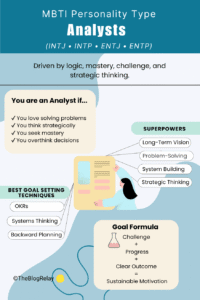
You might be an Analyst if…
- You find most goal-setting advice frustratingly vague — you want the logic, not the motivational speech.
- You set high standards for yourself and feel genuinely unsatisfied when results are merely ‘good enough.’
- Your idea of a great weekend involves learning something complex, solving a hard problem, or building something from scratch.
- You would rather work independently with full autonomy than hit a goal as part of a group exercise.
This makes them powerful goal-setters when conditions are right, and spectacular over-engineers when they are not. Building a business, becoming an expert in a field, creating innovative solutions, developing high-value skills, or leading complex projects often feels deeply rewarding because these goals provide what Analysts crave most: challenge.
The irony is that their greatest strength can also become their biggest obstacle.
A new business idea appears. Then another. Then a better one. Then a podcast episode introduces a new framework. Then a book introduces a different strategy. Before long, progress has been replaced by planning.
This phenomenon is often referred to as analysis paralysis, and Analysts are particularly vulnerable to it.
Goal-Setting Blueprint for Analysts
- Use OKRs (Objectives and Key Results) — the framework built for ambitious, measurable mastery-based targets. Set one compelling objective and 2-3 quantifiable key results per quarter.
- Apply Systems Thinking — map the goal as a system: inputs, processes, feedback loops, and outputs. Analysts thrive when they can see how everything connects.
- Try Habit Stacking (Atomic Habits By James Clear) — attach new goal-supporting behaviors to existing routines to build momentum without relying on motivation alone.
- Quarterly Planning — Instead of planning an entire year, break goals into focused 90-day cycles. Analysts can maintain momentum while allowing room for strategic adjustments.
- Progress Tracking Dashboards — weekly metrics, progress dashboards, or performance scorecards turn abstract goals into measurable momentum.

The Diplomats (INFJ, INFP, ENFJ, ENFP): Goals That Feed Your Purpose
Diplomats usually need a deep reason to work on goals.
Values, purpose, personal growth, and impact guide them. They not only care about what they do, but also about why they are doing it. This is why many Diplomats struggle with goals that look impressive but feel empty.
Honestly, that’s one reason I’ve stuck with this blog. If the goal were only traffic numbers, spreadsheets, and analytics dashboards, I probably would have wandered off to a different project by now.
A promotion may sound appealing. More money may sound appealing. Recognition may sound appealing. Yet if those outcomes don’t connect to something meaningful, diplomats don’t hesitate to walk away from them.
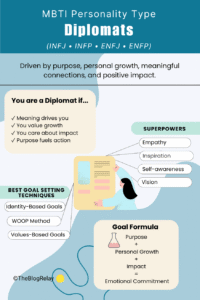
You might be a Diplomat if…
- You have abandoned a goal the moment it stops feeling meaningful, even if you were close to finishing.
- Your notebook is full of beautiful ideas, passion projects, and half-started plans that never quite launched.
- Good pay is never enough on its own for you.
- You give a lot of yourself to goals and causes, and frequently end up burned out before the finish line.
When Diplomats believe in a goal, they can demonstrate extraordinary commitment.
This explains why Diplomats are often drawn toward writing, teaching, coaching, mentoring, creative work, community building, and projects that create positive change.
This is their greatest superpower. It’s also the setup for their most common failure.
Diplomats tend to set too many purpose-driven goals at once because everything feels important when you are values-led, and choosing one feels like betraying the rest. The result is a life that looks rich on paper and feels scattered in practice.
Goal-Setting Blueprint for Diplomats
- Use the Ikigai Framework — map your goals at the intersection of what you love, what you are good at, what the world needs, and what you can be paid for. Goals that live in that overlap have staying power.
- Identity-based goals – Popularized by James Clear, these goals focus on who you want to become rather than what you want to achieve. For example, “Become a writer” instead of “Write one book.”
- Practice Values-Based Goal Setting — write a personal ‘why statement’ for every goal. If it doesn’t connect to a core value, reconsider whether it’s your goal or someone else’s.
- Limit active goals to one or two — depth beats breadth for Diplomats, every single time. The Essentialism approach (Greg McKeown) is tailor-made for this group.
- Find a values-aligned accountability partner — human connection fuels Diplomat follow-through in a way solo tracking systems simply can’t replicate.
The Sentinels (ISTJ, ISFJ, ESTJ, ESFJ): Goals That Honor Your Structure
Sentinels are often motivated by something less glamorous but incredibly powerful: responsibility.
They tend to value reliability, stability, commitment, and follow-through. In a world obsessed with hacks, shortcuts, and overnight success stories, Sentinels often succeed through a much less exciting strategy. They keep showing up. And then they keep showing up again.
Sentinels are often more comfortable with routines than most people. They appreciate structure, like knowing what needs to be done and when. They are also usually busy following the one that’s already working. This makes them particularly well-suited to long-term goals.
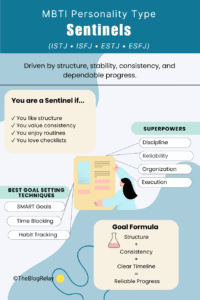
You might be a Sentinel if…
- You feel genuinely uncomfortable starting something new without a clear plan and defined milestones.
- People often describe you as dependable.
- Your to-do lists have to-do lists, and you enjoy checking things off a list.
- You follow through on commitments, even when you don’t feel like it.
Sentinels are the most consistently reliable goal pursuers in the MBTI world — once they commit, they commit fully. For them, the challenge is recognizing when to stop.
A routine may continue long after it stops serving them. A career path may continue simply because it’s familiar. A goal may remain on the list because it’s always been there.
Goal-Setting Blueprint for Sentinels
- Use SMART Goals (Specific, Measurable, Achievable, Relevant, Time-bound) — the framework most naturally suited to how Sentinels already think.
- Apply Getting Things Done (GTD) — a trusted system for capturing, organizing, and executing goals with the kind of sequential clarity Sentinels need to feel in control.
- Use Time-Blocking — schedule dedicated focus windows for goal work. Seeing goal time protected on a calendar transforms abstract commitment into a visible structure.
- Set goals across life categories (career, health, relationships, learning) — Sentinels feel most grounded when their goal landscape is organized and complete, not randomly prioritized.
- Schedule weekly/quarterly reviews — explicitly give yourself permission to update or release goals that no longer align with your priorities.
For Sentinels, the Clever Fox Planners Pro is a natural fit, a comprehensive and structured goal-tracking system.
The Explorers (ISTP, ISFP, ESTP, ESFP): Goals That Match Your Energy
Explorers are driven by curiosity, experience, adaptability, and a desire to discover.
They like movement, experimentation, and figuring things out as they go. Explorers are the most action-native personality group in the MBTI world. They are willing to take risks, try new approaches, and adapt quickly when circumstances change. This makes them excellent entrepreneurs, creators, performers, adventurers, and problem-solvers.
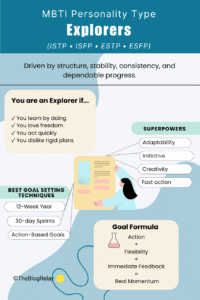
You might be an Explorer if…
- You start strong on almost every goal — it’s the staying that gets you.
- Annual planning feels like a fiction exercise; you can barely picture what you want next quarter, let alone next December.
- You have abandoned goals you were actually good at, simply because the excitement wore off and something new caught your attention.
- Rigid schedules make you restless.
- You do your best thinking in motion; ideas come while doing, not while planning.
If those statements feel familiar, welcome to the Explorer family.
While short-term momentum is their natural habitat, their challenge is to make it outlast the initial excitement. It also creates unique challenges for traditional goal-setting, as most of them are built around structure – detailed plans, timelines, milestones.
Give an Explorer a rigid twelve-month plan, and there’s a reasonable chance they’ll begin searching for emergency exits before reaching page two.
Individuals with this personality type may abandon any goal if the process becomes repetitive. This is why shorter planning cycles typically work better for them than rigid long-term roadmaps.
Goal-Setting Blueprint for Explorers
- Use the 12-Week Year (Brian Moran) — compress annual goals into 12-week execution cycles. Shorter horizons maintain the urgency and excitement.
- Try 30-Day Sprints — one focused goal, one month, full energy. At the end, consciously renew, revise, or release. This works with the Explorer nature rather than against it.
- Apply Atomic Habits (James Clear) — habit-based goal structures that focus on 1% daily improvement. Small daily wins feel more real to Explorers than distant quarterly targets.
- Use Visual Progress Trackers — habit streaks, progress bars, filled-in trackers. Seeing movement maintains momentum for Explorers in a way abstract metrics never will.
- Run the ‘Bored or Done?’ check-in — before walking away from a goal, ask honestly: am I losing interest because this is wrong for me, or because it just got hard? The answer changes everything.
If you want to go deeper on how your Explorer wiring shapes every area of your professional life, Joel Mark Witt and Antonia Dodge’s Personality Hacker is the most practically useful guide available.
These frameworks are starting points, not rules. Personality helps explain what may feel most natural, but personal experience matters more than any assessment. If a system works for you, even if it doesn’t match your personality group, keep using it.
The best goal-setting method is ultimately the one you’ll actually stick with.
Goal Setting By Personality Type: The Framework
Self-awareness is only as useful as what you do with it. Use the table below as your go-to reference. Bookmark it. Screenshot it. Come back to it every time you are setting goals.
| MBTI Group | Motivated By | Best Goal Style | Best Frameworks | Biggest Traps |
|---|---|---|---|---|
| Analysts | Mastery and achievement | Skill-based | OKRs, Systems Thinking, PAAR* | Over-planning, never starting |
| Diplomats | Purpose and meaning | Purpose-driven | Ikigai, Identity based goals, Values-Based Goals | Too many goals, burnout |
| Sentinels | Stability and consistency | Structure-based | SMART Goals, GTD, Time-Blocking | Obligation goals, fear of change |
| Exploreres | Freedom and experience | Action-first | 12-Week Year, 30-Day Sprints, Atomic Habits | Losing interest mid-pursuit |
*PAAR (Plan, Action, Assess, Reflect) is a flexible goal-setting framework that helps you turn plans into progress. Its balance of structure and adaptability makes it a good fit for all four MBTI personality groups. Read the full guide here: The Ultimate Personal Goal Setting Template: Live Your Way
Notice something important here.
None of these approaches is better than the others. They are simply different. And that’s exactly our point.
Stop Chasing Goals Built for Someone Else
We live in a world where success is constantly on display. Every day, we are exposed to stories about entrepreneurs, creators, athletes, executives, and influencers sharing their routines, habits, and strategies.
Many of those insights are genuinely valuable. The problem begins when we confuse someone else’s path with our own.
We admire the entrepreneur and decide we should build a business. We admire the creator, their income, and their fame, and decide we should start a channel too.
What we are often copying is the visible behavior. What we are missing is the personality underneath it.
A system that energizes an Analyst may drain a Diplomat.
A routine that helps a Sentinel thrive may feel restrictive to an Explorer.
You don’t need another framework. You need the right framework, the one built around the person doing the pursuing, not the goal being pursued.
A goal that feels deeply meaningful to one person may feel completely disconnected to another. It’s about what works for us.
This doesn’t mean we should ignore advice from others. It means we should filter it to suit our personality.
Simon Sinek’s most enduring idea is that the organizations and people who inspire the most don’t start with what they are doing or how they are doing it. They start with why.
Your MBTI personality type is your why, not just for goal setting, but for the entire way you engage with growth, change, and becoming.
5 Questions to Help You Choose Goals That Fit Your Personality
If you’re still unsure which group resonates most or you want to pressure-test a goal before committing, run through these five questions. They will definitely point you in the right direction.
- What types of goals have I successfully stuck with before? Look for patterns. Your past behavior reveals more about your natural motivation than your future intentions.
- What keeps me going after the initial excitement fades? Achievement? Purpose? Structure and routine? Variety and experience? The answer likely maps directly toward your personality group.
- Do I prefer structure or flexibility? Some people thrive with detailed plans. Others need room to adapt. Neither is wrong.
- What kind of progress feels most rewarding? Becoming more skilled? Making a difference? Building stability? Having new experiences? This tells you which goal style will sustain your motivation.
- Am I choosing this goal because I want it or because I admire someone who has it? Chasing someone else’s definition of success can be an exhausting way to live.
Your goals should feel like yours.
The moment you stop measuring yourself against a system that was never built for you, something shifts.
Goals stop feeling like obligations and start feeling like choices.
Progress stops feeling like a struggle and starts feeling like momentum.
That is not magic. That is alignment. And alignment, it turns out, was available to you all along — you just needed to know where to look.
