

You have been staring at your screen for 22 minutes. Not working. Not scrolling. Just… staring.
You opened three tabs comparing project management tools. Bookmarked two articles about ‘choosing the right framework.’ Made a note to ask your colleague what she uses. You know you should just pick one, but you can’t. This is analysis paralysis.
The decision isn’t even that important. But somehow it’s become this thing—this mental tab that won’t close, this low-grade anxiety humming in the background of every other task.
And what makes it even worse is the fact that you know you are overthinking it. But the options still sit there, each one reasonable, none clearly superior. So you stay stuck.
You are stuck because you are trying to make the perfect decision when what you actually need is just a clear one.
Because everything feels important.
And when everything feels important, deciding what to do first becomes the hardest part.
What Analysis Paralysis Actually Is (And Why It’s Not Just Overthinking)
Analysis paralysis is the inability to decide because you are overwhelmed by options, information, or the fear of choosing wrong.

It’s not just overthinking.
Overthinking means you’re mentally processing. “Should I choose Option A or B? Let me think through the pros and cons again.”
Analysis paralysis means you are mentally stuck, running the same comparisons on a loop without ever concluding. “I’ve compared Options A through G seventeen times. I still can’t decide. Maybe I need more information. Let me start over.“
The difference?
Overthinking eventually leads somewhere. Analysis paralysis keeps you frozen.
The Lie We Have Been Sold About Choice
We grew up believing more options meant more freedom. More freedom meant better outcomes. Better outcomes meant better lives.
The logic was airtight: Choice = Control = Success.
Except it’s not true.
Psychologist Barry Schwartz spent decades studying how people make decisions, and what he found contradicts everything we have been taught.
Beyond a certain threshold, additional options don’t improve decision-making; they paralyze it.
Consider what your parents or grandparents faced when making a decision:
- Buying a TV meant choosing between 3-5 models at the local store.
- Picking a restaurant meant scanning a single page in the phone book.
- Learning a skill meant finding the one book the library had on it.
Now consider what you face:
- 47 project management tools, each with 200+ features and 18-minute demo videos.
- 15,087 titles on Netflix (actual number as of 2023)
- 4.3 million results when you Google “how to be productive.”
This isn’t a minor increase in complexity. It’s a fundamentally different cognitive environment.
In practice, choosing among 3 options takes effort. Choosing between 10 feels hard. Choosing between 40 becomes genuinely painful.
But it’s not just the quantity. It’s also the quality of similarity that makes it tough.
If one option were obviously superior, you’d pick it instantly. The problem is that modern options are roughly equivalent. Every tool is “intuitive.” Every framework is “proven.” Every method “works.”
- Tool A has better automation, but Tool B has better support
- Method X is faster, but Method Y is more thorough
- Option 1 costs less, but Option 2 might scale better
None of these comparisons has a clear answer. They are trade-offs, not rankings. And trade-offs require something most people haven’t explicitly defined: what matters most.
Without that, your brain keeps re-running the same comparisons, hoping one will suddenly become obvious. It never does.
What used to be thoroughness is now just paralysis with better PR.
The Second-Order Problem No One Talks About
Decision paralysis creates a hidden cost that’s worse than the decision itself: decision debt.
Every unmade decision sits in your mental stack, consuming background processing power.
You are in a meeting, but part of your brain is still weighing whether to switch email platforms. When trying to sleep, your mind helpfully reminds you that you still haven’t decided about that course you bookmarked.
This is why decision paralysis feels so exhausting.
Economist Herbert Simon coined a term for this in the 1950s: satisficing—a blend of “satisfy” and “suffice.”
The idea was radical then: Stop looking for the optimal choice. Choose the first option that meets your criteria.
In the 1950s, this was settling. Suboptimal. Second-rate.
Today? It’s the only sustainable strategy.
Because the pursuit of optimal in an infinite option space doesn’t lead to better decisions, it leads to no decisions.
And no decision is, by definition, the worst decision.
The Real Problem Isn’t Choice—It’s The Absence of Filters
Here’s what I’ve learned after watching hundreds of people struggle with decisions:
When you don’t know what matters most, everything competes equally for your attention. And when everything competes equally, nothing wins.
You end up in comparison hell:
- “This option is 20% cheaper, but that one has better reviews.”
- “This has more features, but that one is simpler.”
- “This might be overkill, but that might not scale.”
These comparisons are endless because they are contextless. You are comparing features without knowing which features actually matter for your specific situation.
It’s like trying to decide which car to buy without knowing whether you are driving across the country or just commuting 10 minutes to work. The “best” car depends entirely on the context you haven’t defined.
The solution isn’t finding better options. It’s building better filters.
The Decision Lens: From Analysis Paralysis to Clarity
I’m going to show you a decision-making framework that transforms subjective comparisons into objective clarity.
It’s called The Decision Lens, and it works through weighted scoring—a technique that forces you to define what actually matters before you compare anything.
Not all decision factors carry equal weight. But we treat them equally when we haven’t explicitly defined our priorities.
Surbhi mahnot
The Decision Lens template changes that.
Instead of asking “Which option is best overall?” you ask “Which option best fits what matters most in my specific context?”
Let me show you what this looks like in practice.
A few years ago, I spent days researching project management tools—Asana, Trello, ClickUp, Monday.com, Notion, and Basecamp. Eight tabs open. Zero clarity.
Then I used The Decision Lens:
- Non-negotiables: Team collaboration features, under $50/month for a small team, mobile app. (Three platforms eliminated instantly.)
- Weighted criteria: Ease of onboarding (50%), Task visualization (30%), Integration options (20%).
- Scored the finalists: Trello: 2.7, Asana: 2.5, ClickUp: 2.3
- Captured the process: Noted the key details and nuances related to my decision. This greatly improved my awareness for future decisions.
Decision made in 15 minutes. Been using Trello for three years without regret.
The clarity was so immediate that I turned this into a template I’ve used dozens of times since—for hiring decisions, software purchases, content strategies, even choosing which cities to visit on vacation.
And now I’m sharing it with you.
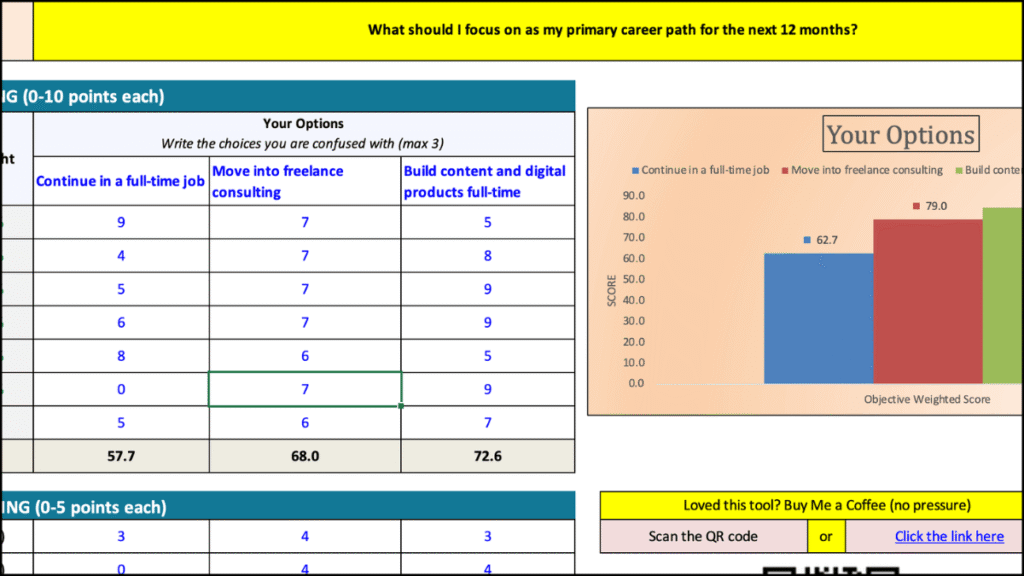
How The Decision Lens Works
The framework has three simple steps:
Step 1: Define and Weight What Matters
The template includes six predefined criteria and allows you to add one more of your choice to help determine the best decision for your situation. Assign weights that reflect their importance.
Most people get this wrong by distributing weights evenly. Don’t. Be honest about what matters most.
Step 2: Score and Decide
Score your three options against your weighted criteria for a decision. The math does the heavy lifting. Set a 24-hour deadline and make the call.
That’s it. Simple structure. Powerful clarity.

Step 3: Record and Learn
Identify key details and mindset shifts learned during the decision-making process for future reflection.
And you are done.
Now, when you look at your options, you are not evaluating them equally.
You are filtering them.
Some things naturally move up.
Some things naturally drop away.
The decision doesn’t become easy, but it becomes clearer. And clarity is what allows movement.
The Decision Lens is powerful when the stakes are significant, options are similar, you are stuck in analysis paralysis, or you need to understand your reasoning.
For low-stakes decisions? Just pick something and move on. Save your decision-making energy for what matters.
The template won’t give you 100% certainty. It will give you 70% certainty with zero mental debt. That’s the trade. And it’s a damn good one.
The professionals who advance fastest aren’t the ones making perfect decisions. They’re the ones making clear, quick decisions, then adjusting based on reality.
Your Next 24 Hours: The Decision Lens Template
I have built The Decision Lens Template with the weighted scoring system already set up. You fill in your criteria, score your options, and the math shows you the answer.
No spreadsheet skills required. No decision fatigue. Just clarity.
Here’s what to do right now:
Pick one decision you have been avoiding. Download the template. Apply the framework. Make the call within 24 hours. Not perfect. Not optimal. Just clear enough to act on.
The Decision You Are Actually Making
Every day you don’t decide is a day you have implicitly chosen the status quo.
And the status quo has a cost: the mental weight of carrying unmade decisions, the opportunities missed while you are “figuring it out,” and the signal you send yourself that you can’t trust your own judgment.
That cost accumulates. Silently. Expensively.
You don’t need more options.
You don’t need more research.
All that you need to know is what matters most.
Because clear decisions executed quickly beat perfect decisions that never happen.
What decision are you making today?
