

DISC personality types reveal why delegation fails and how leaders can finally get it right.
The team was launching a new marketing campaign, and the leader asked a junior analyst to handle the campaign analytics. She was organized, enthusiastic, and eager to take on more responsibility. On paper, it seemed like the perfect match.
A week later, the leader reviewed her work. The report was thorough in some areas, but key insights for the campaign strategy were missing. Though she had followed the instructions faithfully, she didn’t prioritize the right metrics or frame the findings for action.
The gap wasn’t her mistake. It was the leader’s. They had delegated based on availability and energy, not on how she naturally processes information or what drives her to excel.
Most leaders don’t talk about this openly. On LinkedIn, delegation is presented as a virtue—empower people, trust them, let go. In reality, delegation is tricky because it’s not just about giving instructions or trusting people.
Delegation isn’t one-size-fits-all. It’s situational. And it’s behavioral.
People process responsibility, deadlines, and pressure differently. They differ in how much ambiguity they can tolerate, how they treat urgency, and what ownership means to them.
When leaders pause and factor in a person’s DISC style, delegation becomes intentional, and outcomes improve dramatically.
Understanding DISC Personality Types
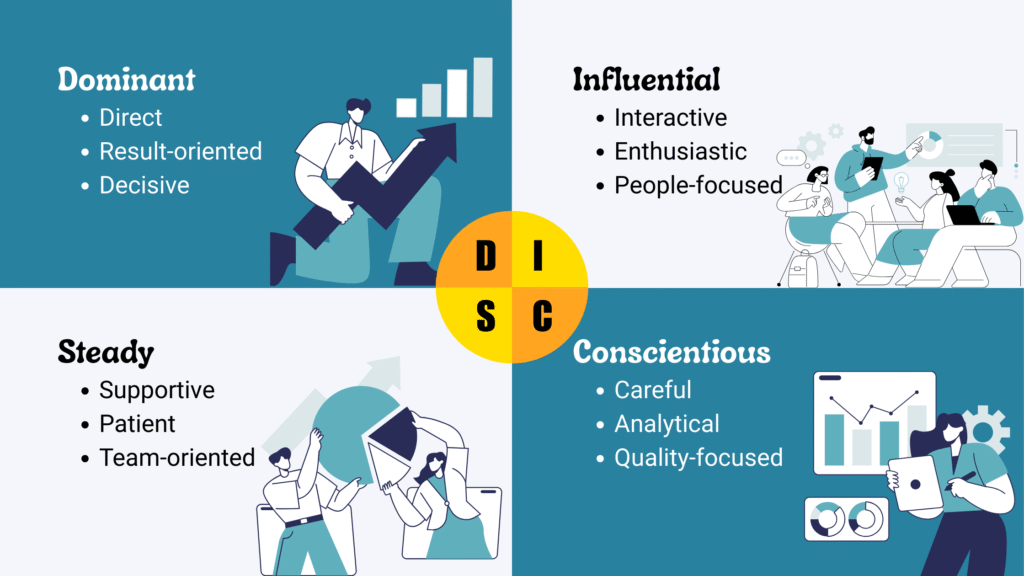
DISC is a behavioral framework that’s been around since the 1920s and has been refined over the decades, explaining how people tend to act, communicate, and respond to pressure, especially in work environments.
DISC stands for four primary behavioral styles:
- Dominant (Direct, Results-oriented, Decisive)
- Influential (Interactive, Enthusiastic, People-focused)
- Steady (Supportive, Patient, Team-oriented)
- Conscientious (Careful, Analytical, Quality-focused)
Most people are a combination of these styles, but under pressure, one behavior usually dominates.
Understanding DISC allows leaders to adapt delegation to the way people process responsibility, rather than imposing a one-size-fits-all approach.
Ready for the challenge? How Good Are You at Delegation? Take The Quiz!
How to Delegate to Different DISC Personality Types
Effective delegation requires understanding how responsibility lands with each person. Here’s how leaders can approach delegation with DISC in mind:
Dominance (D)
The Dominant personality walks into your office like they are already solving the problem before you finish explaining it. They are the ones saying, “Just tell me what needs to happen,” while you are three sentences into the background context.
What drives them: Challenges, autonomy, results, and winning.
What drains them: Micromanagement, lengthy explanations, indecision, and bureaucracy.
How delegation goes wrong: Attempting to soften the approach, adding too much context, or delegating tasks that are too small or too controlled.
How to delegate to D Personalities:
- Get to the point. “I need this market analysis to determine whether we should enter the Southeast Asian market. I need your recommendation by Friday. Your call on methodology.”
- Define the outcome, not the process. D personalities don’t want your playbook; they want the scoreboard. Tell them what winning looks like and get out of the way.
- Include challenge and authority. “This is the project that’s going to make or break our Q3 strategy. You’ll have direct access to the executive team.” Watch them lean in.
- Communication style. Keep it direct, brief, and focused on results. If there’s feedback, give it straight. Agree on the checkpoints rather than regular updates.
The trap? D personalities can bulldoze over people and processes. Your job is to point them in the right direction.
Influence (I)
The Influential personality is the one who turns every project kickoff into a celebration and every setback into a learning opportunity that the whole team should hear about. They are energizing and creative.
What drives them: Recognition, collaboration, creativity, and positive energy.
What drains them: Isolation, repetitive detail work, criticism without relationship, and rigid structure.
How delegation goes wrong: Giving them tasks that lock them in a room with a spreadsheet and no human contact.
How to delegate to I Personalities:
- Connect the task to people and impact. “This presentation isn’t just data—it’s how we inspire the board to believe in this vision. You’re the perfect person to bring that story to life.”
- Build in collaboration opportunities. I personalities do their best work around other people. Structure the delegation to include brainstorming sessions, team check-ins, or presentation opportunities.
- Provide public recognition. Don’t just say “good job” in a private email. Acknowledge their contribution where others can see it.
- Keep initial instructions engaging. Lead with the vision and excitement, then drill into details. Start with “Imagine if we could…” not “Complete items 1 through 17.”
The watch-out? I personalities can over-commit and under-deliver on details. Build in check-points that feel like collaboration, not surveillance.
Steadiness (S)
The Steady personality is the one who actually reads the team charter you spent three hours writing. They are the people who remember everyone’s birthday and somehow know when someone’s having a rough week.
What drives them: Stability, clear expectations, being helpful, and team harmony.
What drains them: Sudden changes, conflict, ambiguity, and being rushed.
How delegation goes wrong: Dropping urgent changes without context, moving goalposts mid-project, or worse—creating situations where they have to choose between quality work and team harmony.
How to delegate to S Personalities:
- Provide clear, step-by-step guidance. “Here’s what success looks like, here’s the timeline, here are the resources you’ll need.”
- Allow time for questions and processing. S personalities are thorough. When you delegate, pause and ask, “What questions do you have?” Then actually wait for the answer.
- Emphasize team impact and support. “This work is going to make everyone’s job easier” resonates more than “This is going to look great on your performance review.”
- Provide reassurance and availability. “I know this is a new challenge. I’m here if you need anything, and I trust you’ll handle this well.”
The nuance? S personalities will rarely tell you they are overwhelmed or disagree with an approach. Create safe spaces for feedback.
Conscientiousness (C)
The Conscious personality is the one asking questions in your delegation meeting that make you realize you hadn’t thought this through as well as you thought. They are the people who find the flaw in your logic, the gap in your data, and the potential disaster you are about to walk into.
What drives them: Accuracy, quality, logic, and expertise.
What drains them: Emotional decision-making, incomplete information, public mistakes, and arbitrary deadlines.
How delegation goes wrong: Stopping them from asking questions or rushing work.
How to delegate to C Personalities:
- Provide comprehensive information upfront. Give them the background, context, constraints, resources, and rationale. It’s the foundation they need to do excellent work.
- Respect their need for analysis time. “I need this thoughtfully done by the end of next week” lands better than “I need this ASAP.”
- Define quality standards clearly. Don’t say “make it good.” Say “We need accuracy within 2% margin of error and all sources cited. Presentation format matters less than data integrity.”
- Be open to questions and alternative approaches. When they ask, “Have you considered…” they are not challenging you.
The challenge? C personalities can get stuck in analysis paralysis. Your job is to help them distinguish between “good enough to move forward” and “perfect.”

Same Task, DISC Personality Types, Four Delegation Styles (Real Example)
Task: Prepare a project update for leadership.
- D-style delegation: “Summarize progress, risks, and next steps. Keep it sharp. Present on Monday.”
- I-style delegation: “Frame this so leadership understands the impact. Feel free to highlight wins.”
- S-style delegation: “Here’s the structure we’ll follow. Let’s review once before finalizing.”
- C-style delegation: “Use this format. Include data sources and assumptions. Accuracy is key.”
The Leader’s Paradox: When Personalities Collide
Here is where leadership gets spicy. You are rarely delegating to people in isolation. You are delegating to teams where your D personality just steamrolled your S personality in a meeting, your I personality forgot to include the data your C personality spent weeks compiling, and everyone’s wondering why collaboration feels like combat.
These are a few personally tested strategies that work wonders:
#1. Play to strengths, compensate for gaps
Put your D personality in charge of driving timelines and decisions. Your I personality owns stakeholder engagement and team morale. Meanwhile, your S personality manages coordination and support. And your C personality handles quality control and analysis. Then make sure they understand they are incomplete without each other.
#2. Create translation moments
When your D personality says, “Just do it,” help your C personality hear, “I trust your expertise—I need your best thinking quickly.” When your I personality says, “Let’s get everyone’s input,” help your D personality understand this isn’t delay—it’s gathering buy-in you’ll need later.
#3. Adjust your check-in style by person
Your weekly one-on-one with a D personality might be 15 minutes of bullet points. With an I personality, it might include relationship-building and big-picture vision. With an S personality, it’s creating a safe space for concerns. And with a C personality, it’s discussing methodology and potential roadblocks.
To most people I have worked with, discussed this, it feels like more work. And it is true. It is more work upfront.
But here’s what I have learned through painful trial and error and what I preach:
You can either invest time in understanding how people work best.
Surbhi Mahnot
Or
You can spend that time (plus interest) managing the chaos when they don’t.
The paradox is this: the more you adapt your leadership style to different personalities, the less you actually have to manage.
People who feel understood work harder, communicate better, and deliver more consistently than people who feel like they are constantly translating your expectations.
Your First Step: The Delegation Audit
Before you implement a whole new system, try this.
Take your last five delegated tasks that didn’t go as planned. For each one, ask yourself:
- Did I explain the outcome the way this person needed to hear it?
- Did I match the task to their natural working style?
- Did I check in using a method that worked for them or for me?
Chances are that you will see patterns. Your D personalities felt micromanaged or I personalities felt isolated. Your S personalities felt rushed or C personalities felt they didn’t have enough information.
They are different people. And require different approaches.
Tailoring delegation does not mean playing favorites; it means matching the work to strengths and tendencies.
Start small. Pick one person. Identify their dominant DISC personality types. Adjust how you delegate the next task. Watch what happens.
Because leadership is about helping everyone become their best. And their best doesn’t need to look like your best. It looks like theirs.
And that, ultimately, is the whole point of building a team.
